
Vitamins are needed for healthy skin not only internally (from your diet) but externally too (from the products you use in your skin care). You probably know all about vitamins A, C and E but you may not have heard about vitamin the skin benefits of vitamin B, D, F and K.
What Is It? Also known as retinal, retinol and retinoic acid. Vitamin A in skin care is great for stimulating cell renewal which encourages healing and boosts collagen production.
Who’s It For? Ideal for ageing skin, but also helpful for acne prone skin.
Notes: Retinol can make your skin more sun sensitive so it’s best used at night. Make sure you wear spf in the day.
What Is It? The two most beneficial B vitamins in skin care are B5 and B3. B5 (also known as pantothenic aicd) helps to restore the skins natural hydrations balance and is great for repairing damaged skin barriers. B3 (a.k.a niacinamide) helps to even out skin tone making it ideal for tackling hyperpigmentation and acne scars. B3 may also help minimise the appearance of large pores and regulate oil production.
Who’s It For? B5 is ideal for dry, dehydrated and sensitive skins. B3 is ideal for uneven skin tones, acne, oily skin.
What Is It? A powerful antioxidant to fight ageing free radicals that your skin comes into contact with daily. Great for evening out skin tone, reducing signs of ageing and brightening the skin.
Who’s It For? Ideal for every skin type, uneven skin tones, pigmentation, ageing skin (which is technically all of us).
Notes: It’s best applied in the morning as a defence aginst daily free radicals. Store away from direct sunlight to prevent oxidisation of the product.
What Is It? Brilliant for reducing inflammation and traditionally used to treat damaged skin. It;s becoming increasingly popular as it is sadi to encourage skin repair and renewal.
Who’s It For? Ideal for very dry skin, eczema, psoriasis.
What Is It? Often labelled as ‘tocopherol’ or ‘tocopheryl acetate’ in skincare. Vitamin E is a powerful antioxidant that helps to prevent UV damage, which is why it is often added to sunscreen formulas. It is soothing, hydrating, anti-inflammatory and helps to strengthen the skin barrier.
Who’s It For? Ideal of dry, sun damaged, or scarred skin.
What Is It? Ok, so technically this one is not a vitamin but in skin care vitamin F refers to linoleic acid (an essential fatty acid rich in omega-6) and alpha-linolenic acid (an essential fatty acid rich in omega-3). These can be found in chia, flax, argan, rosehip, safflower, olive and sunflower oils.
Great for moisture balance, maintaining a strong and healthy stratum corneum (the protective outer layer of your skin), and is anti-inflammatory (so it shouldn’t aggravate acne prone skin).
Who’s It For? Ideal for dry skin, atopic dermatitis (most common form of eczema) and healing the skin.
What Is It? Essential in our diet for wound healing, topically vitamin K also encourages healing of sensitive damaged skin. It is often given to patients post-surgery to reduce swelling and bruising.
Who’s It For? Ideal for compromised skin, scars, broken capillaries, rosacea, eczema, and potentially dark under eye circles.

You don’t need to be using all of these vitamins in your skin care, just pick a couple you feel your skin could benefit from most. I’d say everyone can benefit from vitamin C, and vitamin A if you’re 30 + (or are in your 20’s and dealing with acne).
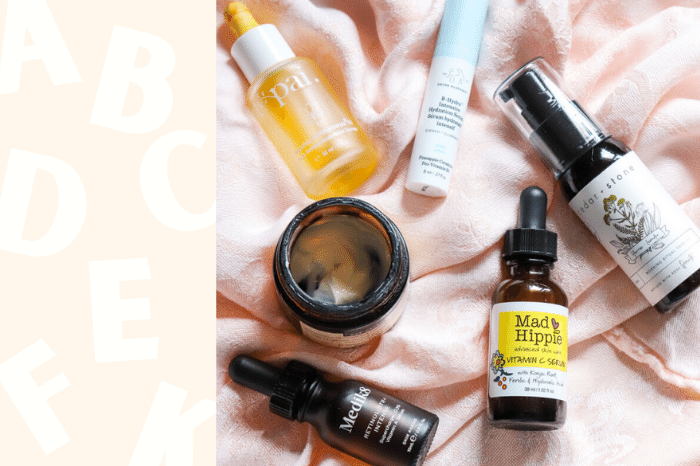
I have recently upped my skincare game by incorporating vitamin A and C into my skincare routine. I use a vitamin C serum in the day (I’m trialling this one) and every other night I use a vitamin A serum (I’ve been using this one).
To get more bang for your buck, choose a serum formula. Typically, serums contain a higher percentage of active ingredients (the ingredients that target your skin concern). For example, if you want vitamin C to brighten your complexion, you’ll get a more potent dose of vitamin C in a serum than you would in a moisturiser.