
Let’s get straight into the definition, differences and benefits of the 4 biotics: prebiotics, probiotics, synbiotics and postbiotics.
You’re going to be a biotic boffin by the end of this post.

What are prebiotics?
Prebiotics are non-digestible dietary substances, often fibre, that act as a fuel for gut microbiota (beneficial bacteria, yeast and archaea). Think of prebiotics like fertiliser helping the flowers grow.
What are the benefits of prebiotics?
When gut microbes ferment the prebiotics they produce beneficial metabolites including anti-inflammatory short chain fatty acids (SCFAs) acetate, butyrate and propionate, lactate and gases. Benefits of prebiotics include:
Examples of prebiotics
Types of prebiotics include inulin, fructooligosaccharides (FOS), galactooligosaccharides (GOS), xylooligosaccharides (XOS), raffinose, resistance starch, polyphenols cellulose and glucomannan.
Prebiotics are found in plant based foods such as:
Synthetic prebiotics that may be added to food, supplements or certain medications include: lactitol (made via hydrogenation of lactose (a sugar in milk)), lactulose in UHT milk, acacia gum and partically hydrolised guar gum (PHGG) – all of which may help alleviate constipation.
Not sure if you’re getting enough prebiotics and fibre?
Track your intake. Mix it up. Challenge yourself to eat the rainbow 🌈

What are probiotics?
The World health organisation (WHO) defines probiotics as “live micro-organisms that, when administered in adequate amounts, confer a health benefit to the host”.
Essentially this means that a probiotic:
Technically, fermented foods are not probiotics because the number of microbes in the food can vary greatly, the specificstrains cannot be identified and the microbes have not been tested in trials for specific health benefits. Instead, the International Scientific Association for Probiotics and Prebiotics terms them sources of “live dietary microbes”. Or just fermented foods to you and I.
What are the benefits of probiotics?
Areas with strong of emerging eveidence for the benefits of probiotics include:
Digestive health
– reducing antibiotic associated digestive issues
– reducing IBS symptoms such as constipation, diarhhoea, gas and abdominal pain
– reducing the risk of traveler’s diarrhea
Respiratory health
– reducing upper respiratory tract infections
Oral health
– reducing dental caries
Metabloic health
– improving metablic health
– reducing non-alchoholic fatty liver disease (NAFLD)
Urogenital health
– reducing bacterial vaginosis and thrush
Skin health
– improving rosacea
– reducing psoriasis severity
– preventing the development of eczema
Mental health
– reducing anxiety
– reducing mild to moderate depression
However, the benefits of probiotics are strain specific and dose specific.
Example of probiotics
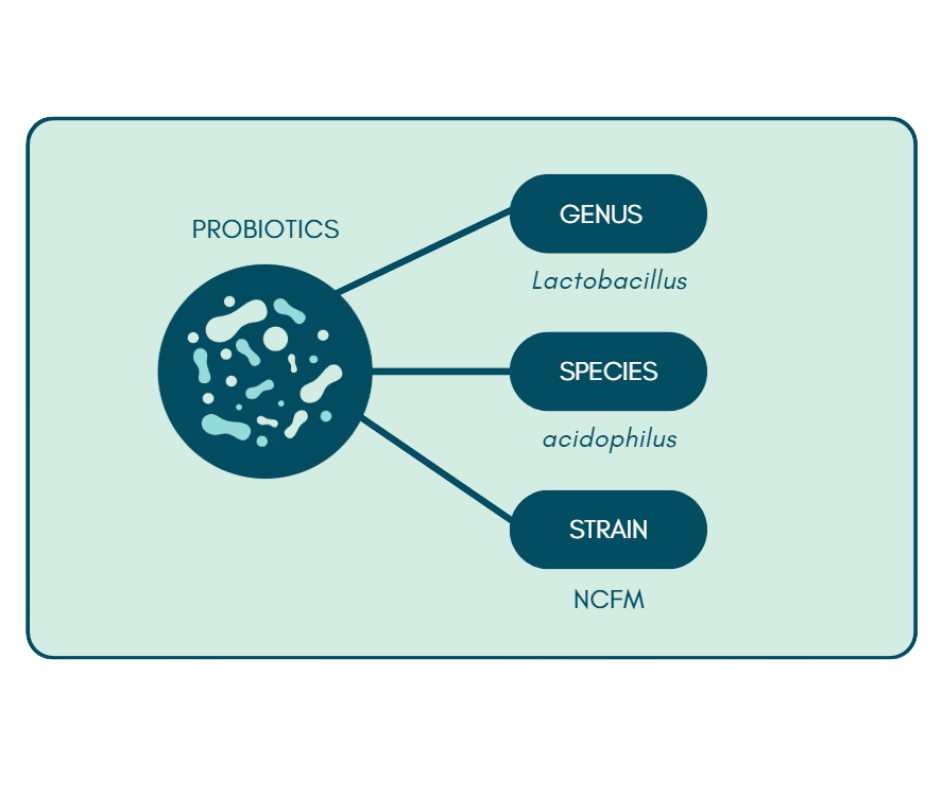
When looking at a probiotic supplement you should see the micro-organism’s genus, species and strain. The genus and species will be written in italics. The strain is usually a bunch of letters and/or numbers. Common genera (the plural of genus) of probiotics include Bifidobactererium, Lactobacilli, Bacillus and Saccharomyces.
Examples of strain specific benefits of probiotics:
*Previously thought to be a species, Saccharomyces boulardii is now considered to be a strain of the Saccharomyces cerevisiae species.
Saccharomyces = the genus
cerevisiae = the species
boulardii = the strain
What are synbiotics?
Synbiotics are products that contain both probiotics (live micro-organisms) and prebiotics (fuel for the micro-organisms).
There are two subtypes of synbiotics:
1. Synergistic synbiotics
This is when the prebiotic is chosen specifically to feed the probiotic that comes with it. Essentially, the micro-organism is matched with it’s preferred fuel source so the probiotic has a better chance of surviving and doing its job.
2. Complementary synbiotics
This is when a probiotic and a prebiotic are included together, but the prebiotic is designed to provide fuel for existing gut micro-organisms, not just the added probiotic. Most commercially available synbiotics are complementary synbiotics.
What are the benefits of synbiotics?
The main benefit of a synbiotic is that pairing probiotics with prebiotics helps support the growth of beneficial gut micro-organisms and supports their production of health promoting metabolites, such as short-chain fatty acids (SCFAs).
Examples of synbiotics
An example of a synbiotic would be a supplement that contains Lactobacillus rhamnosus LGG and fructooligosaccharide fibre (FOS).
Common prebiotics added to a probiotics are:
What are postbiotics?
Postbiotics are the beneficial metabolites and chemicals produced as byproducts of microbial fermentation of prebiotic fuel sources.
What are the benefits of postbiotics?
Postbiotics are more stable than probiotics because they don’t contain live bacteria. Research suggests they may be a useful adjunct therapy in helping to combat antibiotic-resistant bacteria, such as Klebsiella pneumoniae. Key benefits of postbiotics include:
Examples of postbiotics
Postbiotics can include:
To get the benefits of postbiotics from food ensure you eat:
A simple summary:
References
Alder, G. (2023, Oct 31). Prebiotics: You are what your microbes eat. Invivo. https://invivohealthcare.com/blogs/education/prebiotics-you-are-what-your-microbes-eat
Aghamohammad, S., Sakaki, F., Haghighatshenas, Z., Khiavi, E. H. A. G., Badmasti, F., & Rohani, M. (2025). Novel antimicrobial strategy: native postbiotics synergize with antibiotics to overcome resistance in Klebsiella pneumoniae. BMC microbiology, 25(1), 723. https://doi.org/10.1186/s12866-025-04474-7
Axling, U., Önning, G., Combs, M. A., Bogale, A., Högström, M., & Svensson, M. (2020). The Effect of Lactobacillus plantarum 299v on Iron Status and Physical Performance in Female Iron-Deficient Athletes: A Randomized Controlled Trial. Nutrients, 12(5), 1279. https://doi.org/10.3390/nu12051279
Bedu-Ferrari, C., Biscarrat, P., Langella, P., & Cherbuy, C. (2022). Prebiotics and the Human Gut Microbiota: From Breakdown Mechanisms to the Impact on Metabolic Health. Nutrients, 14(10), 2096. https://doi.org/10.3390/nu14102096
Crowch, M. (2024, Feb 13). Classification of Saccharomyces boulardii. Probiotic professional for health professionals. https://www.optibacprobiotics.com/uk/professionals/latest-research/general-health/classification-of-saccharomyces-boulardii
Guarner, F., Sanders, M.E., Szajewska, H., Cohen, H., Eliakim, R., Herrera, C., Karakan, T., Merenstein, D., Piscoya, A., Ramakrishna, B., Salminen, S. (2023, Feb). Probiotics and prebiotics. World Gastroenterology Organisation Global Guidelines. https://www.worldgastroenterology.org/guidelines/probiotics-and-prebiotics/probiotics-and-prebiotics-english
Hoppe, M., Önning, G., Berggren, A., & Hulthén, L. (2015). Probiotic strain Lactobacillus plantarum 299v increases iron absorption from an iron-supplemented fruit drink: a double-isotope cross-over single-blind study in women of reproductive age. The British journal of nutrition, 114(8), 1195–1202. https://doi.org/10.1017/S000711451500241X
International Scientific Association for Probiotics and Prebiotics. (2020). The Science of Prebiotics. Cereal Foods World, Vol. 65, No. 3 https://www.cerealsgrains.org/publications/cfw/2020/May-June/Pages/CFW-65-3-0027.aspx
International Scientific Association for Probiotics and Prebiotics. (N.d, accessed 2025, Nov 24). Fermented Foods: Not all fermented foods contain probiotics. https://isappscience.org/topic/fermented-foods/
Ma, L., Tu, H., & Chen, T. (2023). Postbiotics in Human Health: A Narrative Review. Nutrients, 15(2), 291. https://doi.org/10.3390/nu15020291
McFarland L. V. (2010). Systematic review and meta-analysis of Saccharomyces boulardii in adult patients. World journal of gastroenterology, 16(18), 2202–2222. https://doi.org/10.3748/wjg.v16.i18.2202
Swanson, K. S., Gibson, G. R., Hutkins, R., Reimer, R. A., Reid, G., Verbeke, K., Scott, K. P., Holscher, H. D., Azad, M. B., Delzenne, N. M., & Sanders, M. E. (2020). The International Scientific Association for Probiotics and Prebiotics (ISAPP) consensus statement on the definition and scope of synbiotics. Nature reviews. Gastroenterology & hepatology, 17(11), 687–701. https://doi.org/10.1038/s41575-020-0344-2
Waitzberg, D., Guarner, F., Hojsak, I., Ianiro, G., Polk, D. B., & Sokol, H. (2024). Can the Evidence-Based Use of Probiotics (Notably Saccharomyces boulardii CNCM I-745 and Lactobacillus rhamnosus GG) Mitigate the Clinical Effects of Antibiotic-Associated Dysbiosis? Advances in therapy, 41(3), 901–914. https://doi.org/10.1007/s12325-024-02783-3
Qin, Y. Q., Wang, L. Y., Yang, X. Y., Xu, Y. J., Fan, G., Fan, Y. G., Ren, J. N., An, Q., & Li, X. (2023). Inulin: properties and health benefits. Food & function, 14(7), 2948–2968. https://doi.org/10.1039/d2fo01096h