
Okay, I can’t lie TikTok inspired me to write this post. I keep seeing videos of women experiencing fatigue, irritabilty or hair loss and being told by their doctor that there is no reason for their symptoms. Yet their ferritin level is very low.
This happen to me. I was struggling to concentrate and was loosing a lot of hair. My doctor ran some blood tests and told me everything was “normal”, despite my ferritin being 16 ug/L.
I hope this post sheds some light on what ferritin is, how both low and high ferritin levels may your impact health and what you can do about it. As always, I have packed this post with information so feel free to skim read and skip to the subheadings that are most relevant to you.
Ferritin is a protein that takes in excess iron from cells and stores it for future use, releasing the iron when the body needs it.
Ferritin levels can indicate iron status, inflammation levels, infection and certain cancers.
Conventional reference ranges for ferritin:
• For females 15 – 200 ug/L
• For males 15 – 300 ug/L
Reference ranges can vary slightly from lab to lab. For example, NHS North Bristol state the adult referrence range for ferritin as 11 – 310 ug/L and 24 – 340 ug/L for females and males, respectively.
These are large reference ranges based on values observed in 95% of a population sample. These range of values represent what is common, not what is healthy.
You may wonder why reference ranges don’t reflect optimal health. This is because they are designed to detect clear disease states, such as iron deficiency anaemia, rather than earlier or subclinical deficiencies such as iron deficiency without anaemia. Conventional medicine tends to focus on diagnosing and treating disease, rather than on health optimisation or disease prevention.
As a nutritional therapist I use functional medicine reference ranges, which research shows is what the body needs for optimal health. Therefore, these reference ranges are narrower.
Functional medicine reference ranges for ferritin:
• For females and males 70 – 100 ug/L
From a functional persceptive when ferritin drops below 50 ug/L symptoms may start to appear. For example you may feel persistent fatigue despite rest. Many researchers have argued that the cut off defining iron deficiency without anaemia should be raised from 15 ug/L to 50 ug/L.
When your ferritin is ≤30 ug/L this is considered iron deficiency without anaemia.
The UK’s NICE guidelines state:
“In all people, a serum ferritin level of less than 30 micrograms/L confirms a diagnosis of iron deficiency. Low levels of ferritin can result in symptomatic and functional impairment even in those individuals with a normal haemoglobin, especially in women who are menstruating.”
However, low ferritin alone does not necessarily mean you need to supplement. Ferritin should always be interepreted as part of a full iron panel, as well as considering symptoms.
Full iron panel:
Symptoms of low ferritin include:
Causes of low ferritin include:
Increase your intake of iron rich foods. Dietary iron comes in two forms: heme iron, found in meat, poultry, and fish, which is more easily absorbed; and non-heme iron, found in plant foods.
Sources of dietary iron:
The recommend daily intake of iron is:
• Menstrauting females: 14.8 mg
• Pregnancy: 27 mg
• Males and non-menstruating females: 8.7 mg
Tips to help maximise iron absorption from food:
Iron supplementation. Only supplement with iron if your iron levels have been tested and you’ve been advised that you are iron deficient.
If supplementation is needed, look for iron bisglycinate (ferrous bisglycinate). This form is generally better absorbed and less likely to cause constipation compared with ferrous fumarate or ferrous sulfate. Choosing a supplement that also contains vitamin C can further enhance iron absorption. For example, ‘Easy iron by Terranova‘ or ‘Gentle iron and vitamin C by Dr.Vegan‘.
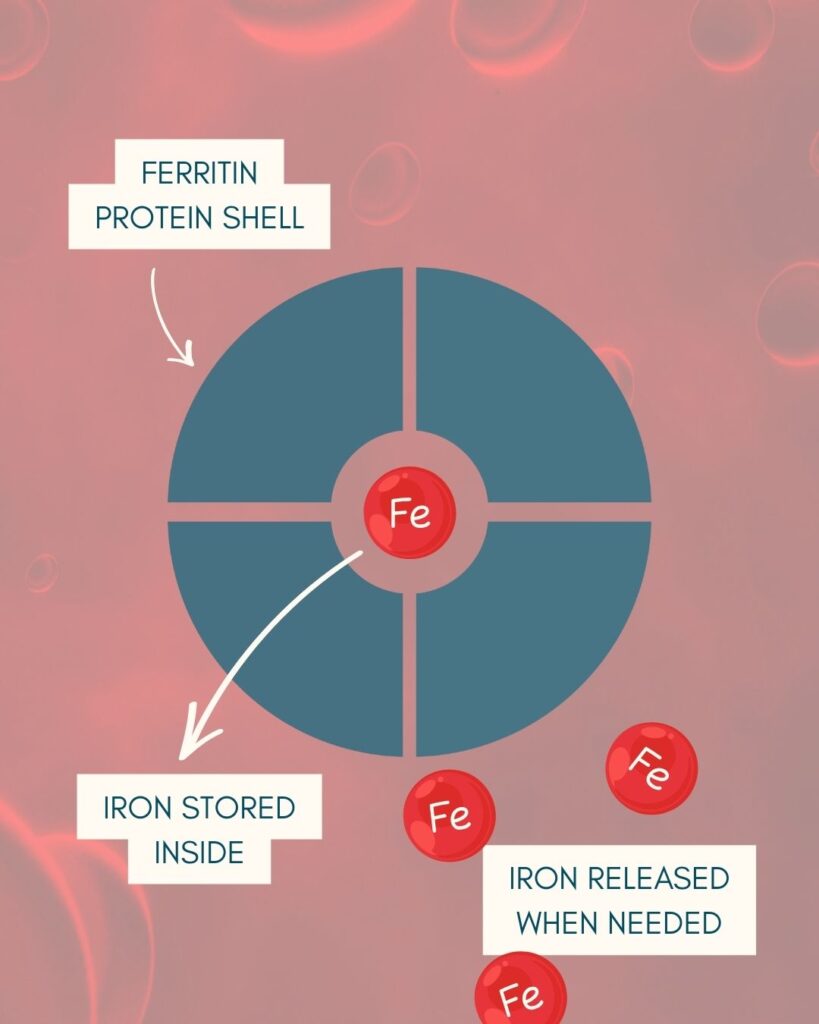
Simple depiction of ferritin
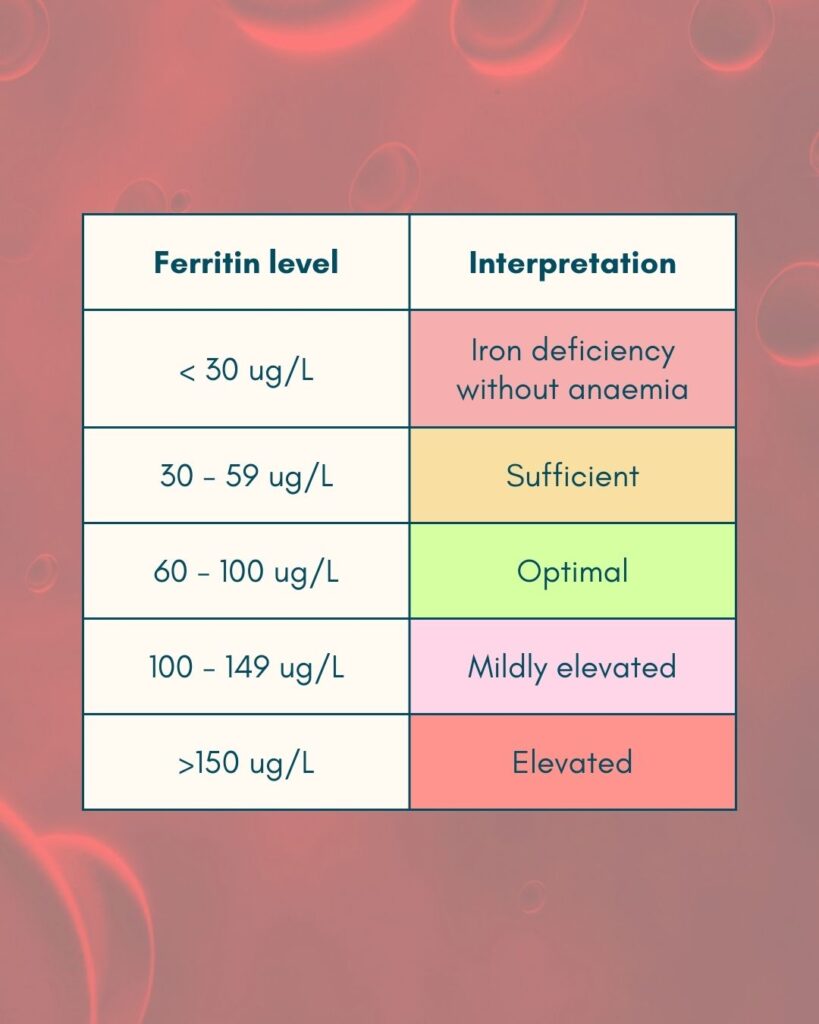
Reference ranges from a functional medicine perspective
Too much iron can be just as problematic as too little. Excess iron is toxic and can damage cells.
The World Health Organization states:
“A ferritin concentration exceeding 150 µg/L in menstruating women and 200 µg/L in men and non-menstruating women who are otherwise healthy may indicate a risk of iron overload .”
Symptoms of high ferritin include:
Causes of high ferritin may include:
Firstly, the cause of high ferritin and/or iron needs to be established. Your doctor may conduct the following investigations to establish the cause:
If iron overload is a concern, strategies to help lower iron levels include:
If for whatever reason your are unable to obtain your iron levels from your doctor there are home tesing options.
I would recommend a venous blood draw rather than a finger-prick test. Finger-prick tests collect a very small capillary blood sample and can be less reliable when assessing iron status. A venous blood draw provides a larger sample from a vein, which generally allows for greater accuracy and more reliable results.
Home testing options for ferritin and iron include:
References
Cancado, R. D., Leite, L. A. C., & Muñoz, M. (2025). Defining Global Thresholds for Serum Ferritin: A Challenging Mission in Establishing the Iron Deficiency Diagnosis in This Era of Striving for Health Equity. Diagnostics (Basel, Switzerland), 15(3), 289. https://doi.org/10.3390/diagnostics15030289
Kotla, N. K., Dutta, P., Parimi, S., & Das, N. K. (2022). The Role of Ferritin in Health and Disease: Recent Advances and Understandings. Metabolites, 12(7), 609. https://doi.org/10.3390/metabo12070609
Knowler, K. (2020). Blood labs: a guide to interpreting blood test results for fatigue.
Lambert Sports Clinic. (2025, Jan). Finger-Prick vs Venous Blood Tests: Why Accuracy Matters for Your Health Decisions. https://lambertsportsclinic.co.uk/blog/finger-prick-vs-venous-blood-tests.html
Martens, K., & DeLoughery, T. G. (2023). Sex, lies, and iron deficiency: a call to change ferritin reference ranges. Hematology. American Society of Hematology. Education Program, 2023(1), 617–621. https://doi.org/10.1182/hematology.2023000494
National Heart, Lung, and blood Institiute. (2022, Mar 24). Iron-Deficiency Anemia. https://www.nhlbi.nih.gov/health/anemia/iron-deficiency-anemia
NICE. (2025, Oct). Anaemia – iron deficiency: What investigations should I arrange to confirm iron deficiency anaemia? https://cks.nice.org.uk/topics/anaemia-iron-deficiency/diagnosis/investigations/
NHS. (2020, Aug 3). Iron: vitamins and minerals. https://www.nhs.uk/conditions/vitamins-and-minerals/iron/
NHS, North Bristol. (2025, Feb). Ferritin. https://www.nbt.nhs.uk/severn-pathology/requesting/test-information/ferritin
World health organization (WHO). (2023, Aug 9). Use of ferritin concentrations to assess iron status in individuals and populations. https://www.who.int/tools/elena/interventions/ferritin-concentrations