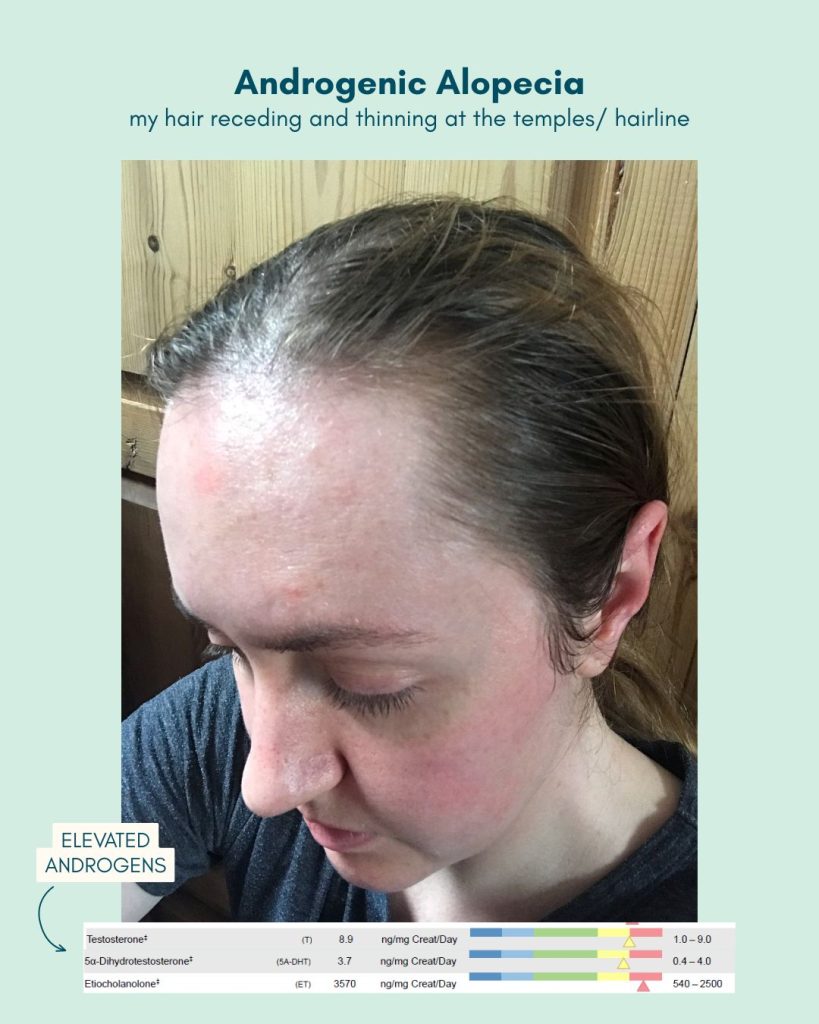
Over the past couple of years, I’ve been experiencing hair loss both on my head and in my eyebrows. After little help from the NHS, I went to see a trichologist at Clinihair who diagnosed androgenic alopecia effecting my hairline and hair parting.
Unfortunately, she could figure out what the heck is causing my eyebrows to fall out (the ends and mid sections are almost non-existent, the skin is inflamed and very sore). I guess it’s a case for me to put my nutritional therapist detective hat on and solve myself. Anyway, that’s a whole other story.
I wasn’t surprised to hear that androgens were the reason for my scalp hair loss, as I already have several clinical signs associated with higher androgen activity, including: oily, acne-prone skin and hirsutism. A comprehensive hormone test I had earlier this year also showed elevated androgen levels.
I’ve tried a number of different approaches to address my hair loss, and I’ve written more about my hair loss and what I’ve done so far over on Substack.
First, let’s clarify some terminology…
Androgenic alopecia and androgenetic alopecia are often used interchangeably, although they can describe different mechanisms of hair loss.
I have elevated androgen levels but no known family history of hair loss. I consider my hair thinning to be primarily androgen-driven rather than the typical genetically predisposed pattern. However, because androgenetic alopecia is the term most commonly used in research on pattern hair loss, I’ll use it throughout this article.
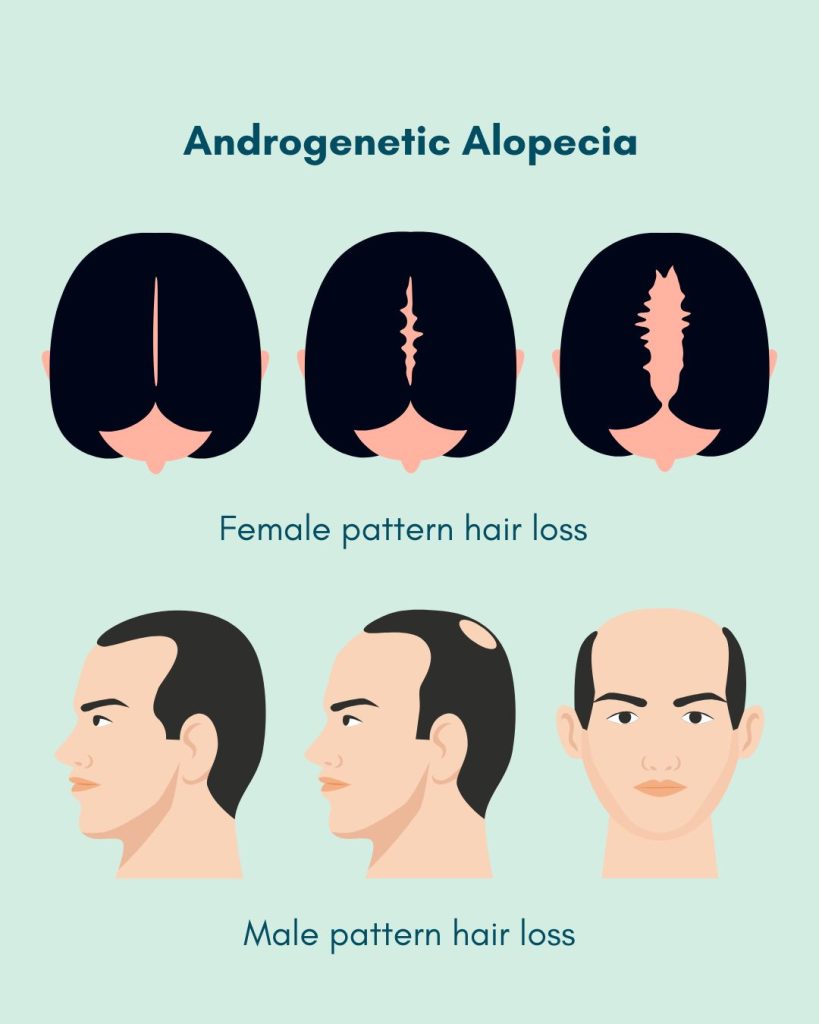
Androgenetic alopecia (AGA), also referred to as male pattern baldness or female pattern hair loss (FPHL), is the most common form of hair loss where there is progressive miniaturization of the hair follicle and a shorter hair growth phase (anagen phase). This leads to hair thinning or baldness over time.
Androgenetic hair loss occurs when hair follicles are particularly sensitive to androgens, especially dihydrotestosterone (DHT). DHT is a potent metabolite of testosterone, produced when the enzyme 5α-reductase converts testosterone into DHT.
In people who are genetically susceptible, DHT binds to receptors in the hair follicles and causes them to gradually shrink. This process, known as follicular miniaturisation, changes the hair growth cycle too. The growth (anagen) phase becomes shorter, while the rest (telogen) phase becomes longer. Over time, thick, pigmented hairs gradually become finer, shorter and paler, eventually developing into vellus hairs (colloquially called ‘peach fuzz’). As the follicles become progressively smaller, the hairs become less visible and overall hair density decreases.
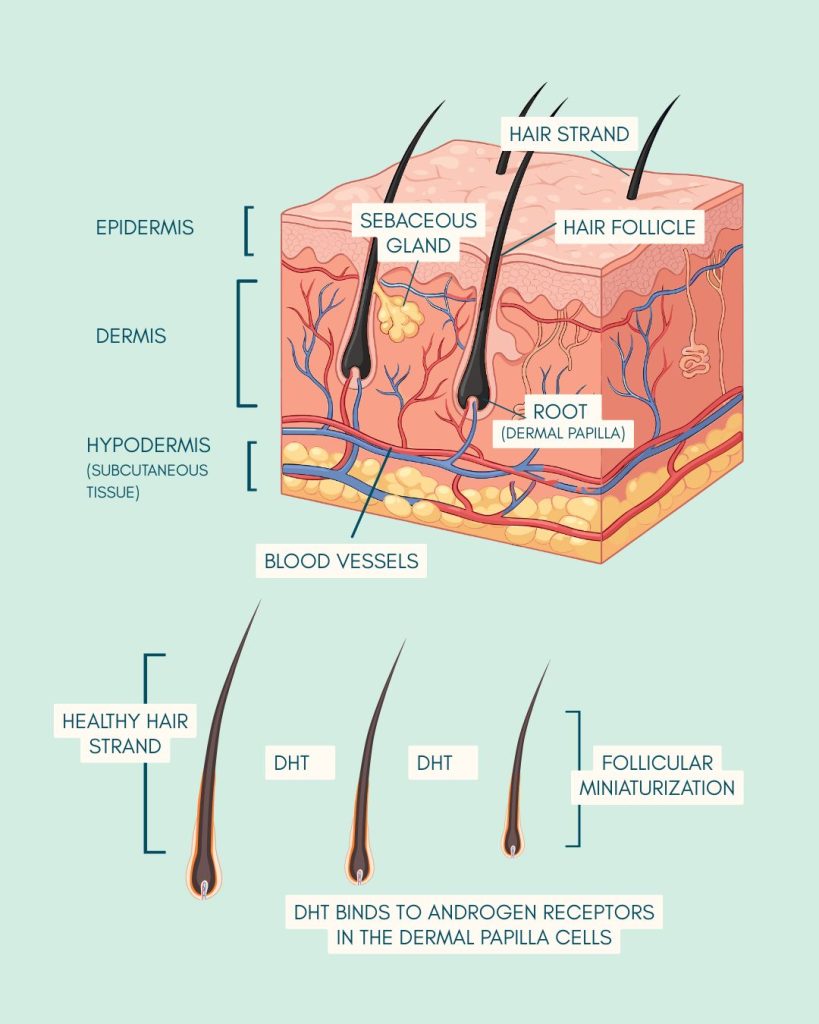
Hair follicle diagram and impact of DHT
Androgenetic alopecia can occur in both males and females. In males the hairline starts to recede whereas in female hair thinning is usually noticed as a widening of the hair parting.
You may notice:
Interventions aim to treat androgenetic alopecia via various mechanisms including:
Diet
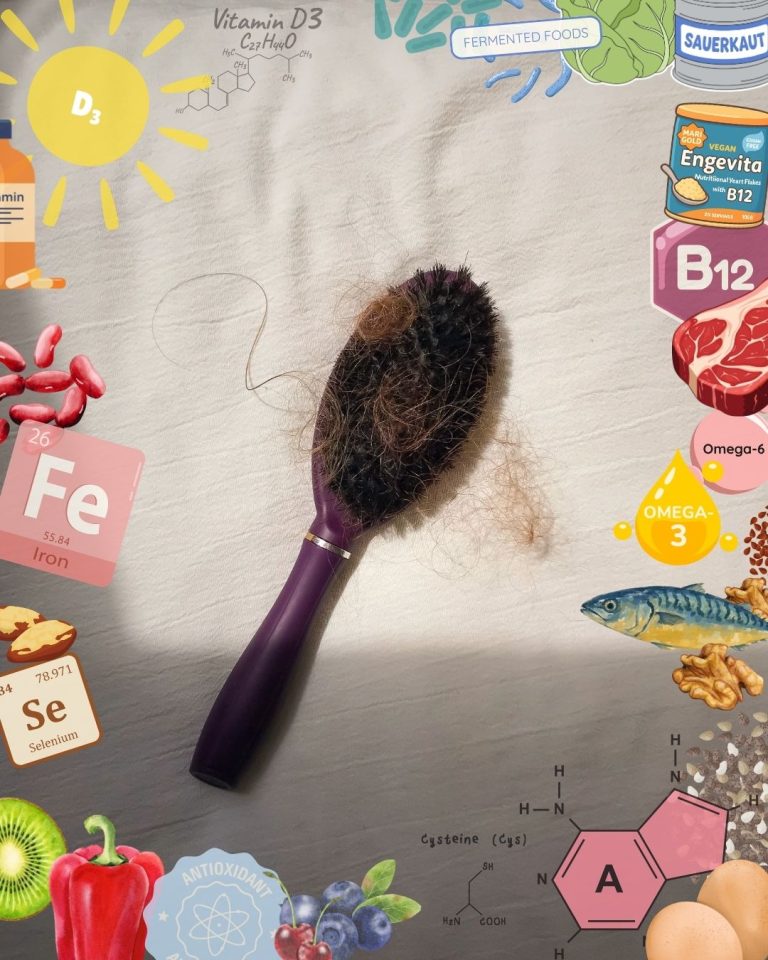
Hair growth requires a steady supply of nutrients particularly protein, iron, zinc, B vitamins, vitamin D, essential fatty acids, and antioxidants.
Hair health is also influenced by inflammation, thyroid function, digestion, stress and sleep.
Focus on balanced meals containing quality protein, colourful vegetables, whole grains and mineral rich foods such as leafy green vegetables, eggs, nuts, seeds and legumes. Limit ultra-processed foods, excess added sugar and trans fats, which may promote inflammation when consumed regularly.
I have gone into more detail on key nutrients for hair health in this post.
If you’d like personalised support to explore whether your diet, nutrient status or other lifestyle factors could be contributing to your hair concerns, I offer 1:1 nutritional therapy consultations.
Supplements
Pumpkin seed oil
Pumpkin seed oil contains beta-sitosterol which helps partially block 5-alpha reductase, the enzyme that turns testosterone into DHT. Additionally, pumpkin seed oil contains anti-inflammatory nutrients such as zinc, vitamin E and polyunsaturated fatty acids that may help reduce inflammation, and support hair follicle and scalp nourishment.
A randomised control trial (RCT) by Cho et al. (2014) enrolled 76 males with mild to moderate androgenetic hair loss. The study found supplementation with 400 mg of pumpkin seed oil per day for 24 weeks resulted in a 40% mean increase in hair count, compared to just 10% in the placebo group. However, because this was a relatively small study conducted only in men, the same effect may not be seen in women.
A 2026 systematic review and network meta-analysis by Zhou et al. found that pumpkin seed oil supplementation significantly improved hair density, while blinded physician assessments also rated it favourably for hair growth. The authors did note that the evidence is still limited, and larger, higher-quality trials are needed to better evaluate its effectiveness.
Saw palmetto
A RTC by Sudeep et al. (2023) found supplementation of 400 mg capsules of standardized saw palmetto oil over 16 weeks reduced hair fall, increased hair density by 5.2% compared with baseline, and reduced serum DHT in males and females with AGA. However, the study was funded by the manufacturer of the saw palmetto and the authors were employees of the manufacturer, raising the issue of bias results.
Vitamins and minerals
Nutrients including iron, zinc, biotin (B7) and vitamin D have been studied in relation to AGA and FPHL, and deficiencies or low levels appear to be more common in some people with hair loss. However, this doesn’t necessarily mean that supplementation will improve hair growth if your levels are already adequate (and ideally optimal).
The most sensible approach is to test for, identify, and correct any nutritional deficiencies rather than taking a long list of supplements ‘just in case’.
A systematic review and meta-analysis by Treister-Goltzman et al. (2022) found that women with non-scarring alopecia (which included AGA and FPHL) had significantly lower iron and/ or ferritin levels compared to women in the general population. Similarly, a review by Yongpisarn et al. (2024) found that vitamin D deficiency is more common in woman with FPHL compared to controls. In these incidences where deficiency has been identified supplementation would be wise.
Biotin is very commonly in hair supplement formulas, but a recent review found that high-quality evidence supporting biotin supplementation for hair loss is lacking.
There is also a potential downside to random supplementation. Some nutrients, including vitamin A and selenium, can cause hair loss when taken in excessive amounts.
Repeat after me – “test, don’t guess”.
Medications
There are medical treatments for androgenetic hair loss, including anti-androgen medications such as spironolactone and finasteride. These fall outside my scope of practice as a nutritional therapist, so I won’t be discussing them.
Topicals
Rosemary oil
There is anecdotal evidence for rosemary oil; you’ve probably seen people talk about in on TikTok. There is some, albeit limited, clinical evidence too. A 2015 RCT by Panahi et al. compared topical rosemary oil with 2% minoxidil in 100 people with androgenetic alopecia. After six months, both groups experienced a significant increase in hair count, with no significant difference between the two groups.
If you do use rosemary oil, ensure it is diluted in a carrier oil such as castor oil. Undiluted essential oils can cause contact dermatitis. I have used this rosemary hair oil by Nikura.
Pumpkin seed oil
Pumpkin seed oil can also be applied topically. A 2021 RCT by Ibrahim et al. found that 1ml of topical pumpkin seed oil showed similar efficacy to 5% minoxidil foam for treating FPHL, with both interventions showing significant increases in hair growth after 3 months.
Minoxidil
By far the most clinically studied treatment for androgenetic hair loss is minoxidil. Minoxidil is not anti-androgenic but it does dilate scalp blood vessels which enhances the delivery of nutrients to the hair follicle. It also prolongs the anagen (growth) phase of the hair cycle.
Multiple RCTs have shown increases in hair count with both 2% and 5% topical minoxidil. The 5% preparation is generally more effective for hair growth but also has more reported side effects such as scalp irritation and itching. My trichologist informed me that reactions are usually not due to the minoxidil but occur due to the other ingredients in the solution such as alcohol. For those with very sensitive skin, like myself, you may need a prescription formulation in a base of tricholsol which is alcohol-free and propylene glycol-free.
As minoxidil falls outside my scope of practice, I recommend speaking to a dermatologist or qualified trichologist if you would like to explore whether it may be appropriate for you.
In summary:
References
Bazmi, S., Sepehrinia, M., Pourmontaseri, H., Bazyar, H., Vahid, F., Farjam, M., Dehghan, A., Hébert, J. R., Homayounfar, R., & Shakouri, N. (2024). Androgenic alopecia is associated with higher dietary inflammatory index and lower antioxidant index scores. Frontiers in nutrition, 11, 1433962. https://doi.org/10.3389/fnut.2024.1433962
Brown, E. I. G., Darling, A. L., Robertson, T. M., Hart, K. H., Li, J., Martin, C., Warren, M. J., Smith, C. P., Lanham-New, S. A., & Elliott, R. M. (2025). Effect of Vitamin D2 Supplementation on 25-Hydroxyvitamin D3 Status: A Systematic Review and Meta-Analysis of Randomized Controlled Trials. Nutrition reviews, nuaf166. Advance online publication.
Chen, S., Li, L., Ding, W., Zhu, Y., & Zhou, N. (2025). Androgenetic Alopecia: An Update on Pathogenesis and Pharmacological Treatment. Drug design, development and therapy, 19, 7349–7363. https://doi.org/10.2147/DDDT.S542000
Cho, Y. H., Lee, S. Y., Jeong, D. W., Choi, E. J., Kim, Y. J., Lee, J. G., Yi, Y. H., & Cha, H. S. (2014). Effect of pumpkin seed oil on hair growth in men with androgenetic alopecia: a randomized, double-blind, placebo-controlled trial. Evidence-based complementary and alternative medicine: eCAM, 549721. https://doi.org/10.1155/2014/549721
Dhaher, S. A., Yacoub, A. A., & Jacob, A. A. (2018). Estimation of Zinc and Iron Levels in the Serum and Hair of Women with Androgenetic Alopecia: Case-control Study. Indian journal of dermatology, 63(5), 369–374. https://doi.org/10.4103/ijd.IJD_624_16
Gupta, A. K., Bamimore, M. A., & Foley, K. A. (2022). Efficacy of non-surgical treatments for androgenetic alopecia in men and women: a systematic review with network meta-analyses, and an assessment of evidence quality. The Journal of dermatological treatment, 33(1), 62–72. https://doi.org/10.1080/09546634.2020.1749547
Gupta, A. K., Bamimore, M. A., & Talukder, M. (2025). Relative Efficacy of Conventional Monotherapies and Select Nonconventional, Over-the-Counter Products for Male Androgenetic Alopecia: A Network Meta-Analysis Study. Journal of cosmetic dermatology, 24(10), e70483. https://doi.org/10.1111/jocd.70483
Ibrahim, I. M., Hasan, M. S., Elsabaa, K. I., & Elsaie, M. L. (2021). Pumpkin seed oil vs. minoxidil 5% topical foam for the treatment of female pattern hair loss: A randomized comparative trial. Journal of cosmetic dermatology, 20(9), 2867–2873. https://doi.org/10.1111/jocd.13976
Lucky, A. W., Piacquadio, D. J., Ditre, C. M., Dunlap, F., Kantor, I., Pandya, A. G., Savin, R. C., & Tharp, M. D. (2004). A randomized, placebo-controlled trial of 5% and 2% topical minoxidil solutions in the treatment of female pattern hair loss. Journal of the American Academy of Dermatology, 50(4), 541–553. https://doi.org/10.1016/j.jaad.2003.06.014
Panahi, Y., Taghizadeh, M., Marzony, E. T., & Sahebkar, A. (2015). Rosemary oil vs minoxidil 2% for the treatment of androgenetic alopecia: a randomized comparative trial. Skinmed, 13(1), 15–21.
Sudeep, H. V., Rashmi, S., Jestin, T. V., Richards, A., Gouthamchandra, K., & Shyamprasad, K. (2023). Oral and Topical Administration of a Standardized Saw Palmetto Oil Reduces Hair Fall and Improves the Hair Growth in Androgenetic Alopecia Subjects – A 16-Week Randomized, Placebo-Controlled Study. Clinical, cosmetic and investigational dermatology, 16, 3251–3266. https://doi.org/10.2147/CCID.S435795
Treister-Goltzman, Y., Yarza, S., & Peleg, R. (2022). Iron Deficiency and Nonscarring Alopecia in Women: Systematic Review and Meta-Analysis. Skin appendage disorders, 8(2), 83–92. https://doi.org/10.1159/000519952
van Zuuren, E.J., Fedorowicz, Z., & Schoones, J. (2016). Interventions for female pattern hair loss. Cochrane Database of Systematic Reviews. 2016, Issue 5. Art. No.: CD007628. DOI: 10.1002/14651858.CD007628.pub4.
Wang, R., Lin, J., Liu, Q., Wu, W., Wu, J., & Liu, X. (2024). Micronutrients and Androgenetic Alopecia: A Systematic Review. Molecular nutrition & food research, 68(22), e2400652. https://doi.org/10.1002/mnfr.202400652
Yelich, A., Jenkins, H., Holt, S., & Miller, R. (2024). Biotin for Hair Loss: Teasing Out the Evidence. The Journal of clinical and aesthetic dermatology, 17(8), 56–61.
Yongpisarn, T., Tejapira, K., Thadanipon, K., & Suchonwanit, P. (2024). Vitamin D deficiency in non-scarring and scarring alopecias: a systematic review and meta-analysis. Frontiers in nutrition, 11, 1479337. https://doi.org/10.3389/fnut.2024.1479337
Zhou, L., Zhu, W., & Chen, Y. (2026). Effects of dietary supplements on androgenetic alopecia: a systematic review and network meta-analysis. Frontiers in nutrition, 12, 1719711. https://doi.org/10.3389/fnut.2025.1719711