
You’re eating better. You’re exercising regularly. You’ve made all those “healthy” changes…
So why is your skin still playing up???
Health powders and supplements are easy to overlook when you’re trying to work out what’s contributing to your breakouts or digestive symptoms. After all, they’re supposed to be helping, right?
But depending on the ingredients, formulation and what your body actually needs, your protein powder could be contributing to bloating, digestive upset or breakouts.
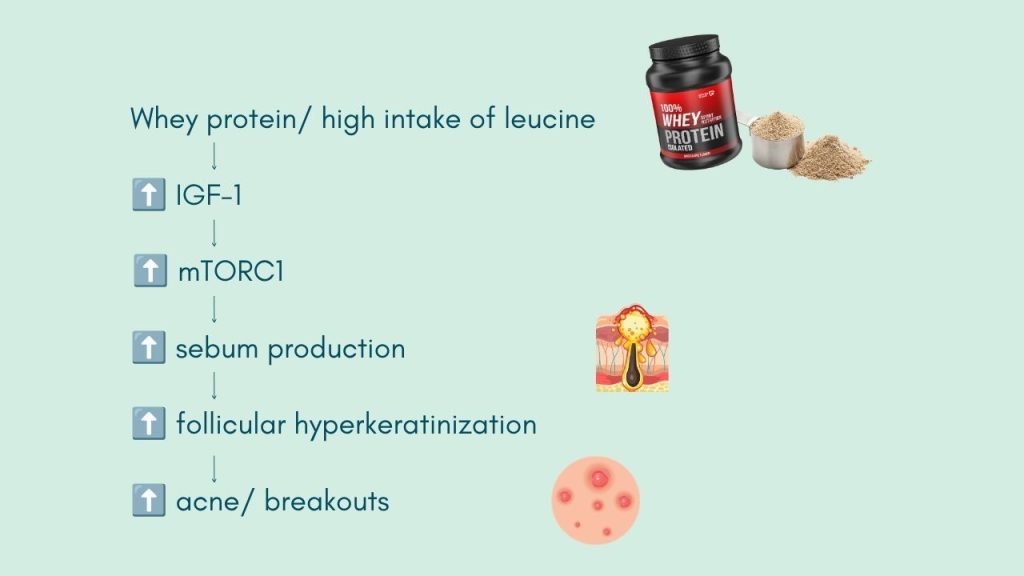
Whey protein is popular for it’s benefits on muscle mass, largely due to it containing all the essential amino acids and in particular high amounts of leucine.
But here’s where it may be problematic for acne-prone skin.
High amounts of leucine increase the production of insulin-like growth factor-1 (IGF-1) which upregulates a pathway called mTORC1 (mammalian target of rapamycin complex-1). Overactivity of mTORC1 contributes to breakouts by acting on androgen receptors, leading to increased sebum production, excess skin cell growth (hyperkeratinisation) and subsequently clogged pores and acne.
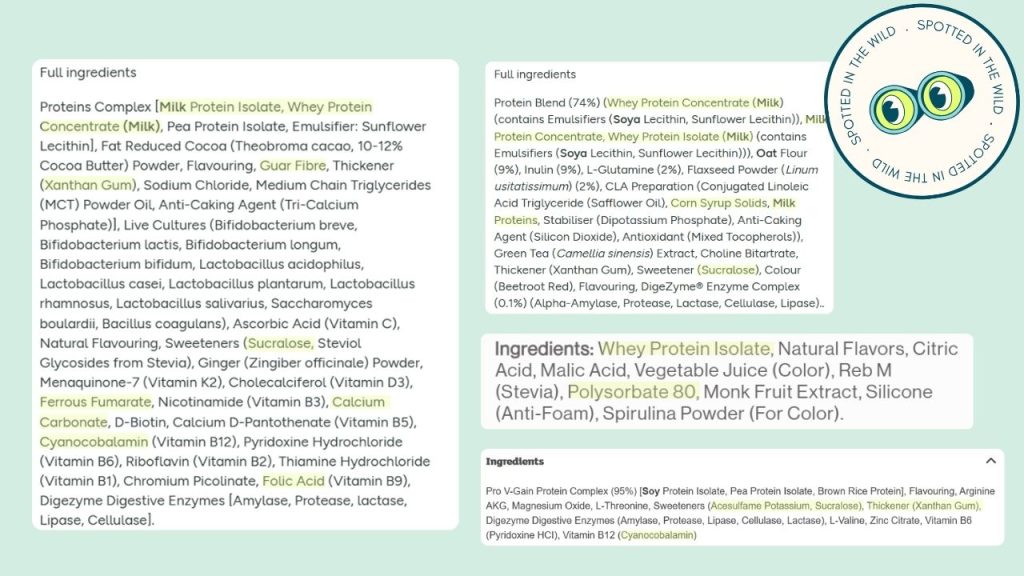
Protein powders can contain much more than protein. Some of the ingredients are genuinely helpful, for example: sea salt to replace electrolytes lost in sweat, or digestive enzymes to help your body breakdown the protein, or turmeric to help quell exercise induce inflammation, but others are not so helpful.
Ingredients to watch out for 👀
➜ Emulsifiers gums and thickeners
Carrageenan, guar gum, locust bean gum, xanthan gum and maltodextrin have all been shown to have negative effects on the gut microbiome. Notably, altering microbial composition, increasing the expression of pro-inflammatory molecules and thinning the protective mucus layer of intestinal lining which can contribute to increased intestinal permeability and inflammation.
Sunflower lecithin is a non-GMO emulsifier, and most research shows neutral or beneficial effects on gut and metabolic health. One study by Naimi et al. (2021) found it increased inflammation and suggested this may be due to its high omega-6 content. However, this study used a model of the gut microbiome rather than human participants.
➜ Sweeteners
I can’t lie, I use a sweetened flavoured protein usually in salted caramel or vanilla so it’d be hypocritical of me to say ‘only use unflavoured protein powder’. However, there are sweeteners I’d recommend avoiding, especially if you are regularly consuming a product, like protein powder, that contains them.
Sucralose
Despite being marketing as ‘zero calorie’ and great for blood sugar balance, research shows that sucralose may actually decrease insulin sensitivity and alter glucose metabolism. This might be due to altering the composition of the gut microbiome, including decreased species that a play a role in metabolic health.
A randomized clinical trial by Méndez-García et al. (2022) found 48 mg of sucralose consumed daily over a 10 week period caused dysbiosis (gut microbiome imbalances) in young adults (n=47, aged 18 to 35).
For context, a typical scoop of protein powder sweetened with sucralose contains around 30–60 mg per serving.
Dysbiosis is associated with acne, making the potential impact of regularly consuming sucralose worth considering if you’re acne-prone.
Sugar alcohols
Sugar alcohols (also called polyols) are commonly used in protein powders and other “low-sugar” products.
Most sugar alcohols are only partially absorbed in the small intestine, causing water to be drawn into the intestine. The sugar alcohol then arrives in the large intestine, where it is rapidly fermented by gut bacteria. This fermentation can cause bloating and gas, while the additional water can contribute to looser stools. This can be particularly noticeable if you have IBS or are sensitive to FODMAPs.
Erythritol is less likely to cause digestive upset because the majority if it is absorbed in the small intestine and only 10% reaches the colon. This means there is considerably less available for gut bacteria to ferment, so erythritol generally results in less gas and is often better tolerated than other sugar alcohols.
That said, tolerance is individual and dose matters. Even erythritol can cause digestive symptoms if you consume a large amount. If your protein powder contains a sugar alcohol, pay attention to how your gut responds.
Better sweeteners options used in protein powders:
➜ Unnecessary added vitamins and minerals
Many protein powders are marketed as health superfoods, with long lists of added vitamins and minerals. I don’t think your protein powder needs to double as your daily multivitamin.
When vitamins and minerals are added, the forms used can vary considerably. For example, you may see iron as ferrous fumarate, calcium as calcium carbonate, magnesium as magnesium oxide, vitamin B12 as cyanocobalamin, and folate as folic acid. These are cheaper suboptimal forms of vitamins and minerals.
The form of a nutrient matters because different forms have different absorption, utilisation and tolerability characteristics. Some people may also find that certain fortified products contribute to digestive symptoms, particularly when they contain a long list of added nutrients alongside sweeteners, gums and other additives.
Furthermore, many nutrients complete for absorption and should not be in the same formula. For example, calcium and iron can compete with one another for absorption, so combining them in a heavily fortified product isn’t a useful way to deliver either nutrient.
Protein powder ingredients that may contribute to acne and digestive discomfort
Ask yourself: Do I actually need protein powder — or have I just been persuaded that I do?
Your individual protein requirements depend on factors such as your build, activity levels, goals, life stage and overall diet.
The recommended protein intake in the UK is 0.75g per kg of bodyweight per day. This has been criticised as insufficient, particularly for maintaining muscle as we age. In my opinion, this is too low if you want to gain or maintain lean muscle. I recommend aiming for at least 1g per kg of bodyweight per day.
Exercise and life stage can increase your protein requirements. From midlife, the risk of sarcopenia (loss of muscle mass and strength) increases. Studies suggest that an intake of 1 – 2g per kg of bodyweight may help support muscle maintenance, while active individuals may benefit from 1.4 – 2g per kg. Requirements can be higher for athletes undertaking regular intense resistance or strength training.
A protein powder may be appropriate if:
Protein powder should not be a replacement for dietary protein from whole foods (fish, meat, eggs, tofu, beans, legumes etc). Think, food first.
I personally use protein powder because I’m very active, and adding a scoop to my post-workout breakfast (usually oatmeal, chia pudding or pancakes) helps me meet my protein needs and support muscle recovery.
More ingredients ≠ better health. Sometimes, simpler really is better.
My top tip is to IGNORE THE MARKETING. Instead, turn the tub or pack around and READ THE INGREDIENTS.
Look at:
The protein source:
Whey, casein, pea, rice, soy or a blend? Pick what suits your preference/ needs best. For acne-prone skin plant based protein powder is generally better.
The sweeteners:
Which ones are used, and do you tolerate them?
The extras:
How many gums, thickeners, flavourings and added nutrients are included? Are the nutrients beneficial* or there for marketing.
*Potentially beneficial:
The serving size:
How much protein are you actually getting per scoop? Ideally 20 to 30g per serve.
Third party testing:
Has it been tested by an independent third party for heavy metals?
As someone with acne prone skin and IBS, these are my protein powder recommendations. They are all plant-based.
★ Vivo life → clean protein (flavoured or unflavoured options) or perform protein (flavoured)
★ Form nutrition → pureblend (unflavoured)
★ Nuzest → clean lean protein (flavoured or unflavoured options)
★ Truvani → plant-based protein (flavoured or unflavoured options)
★ That protein → blissful brown rice & cacao, or peanut butter super protein or mocha protein [note – less for athletic performance at 14g protein per serve, but a great option for those with IBS as they are certified low FODMAP]
★ The British Hemp co → pure hemp protein powder [note – can turn food swamp coloured]
1. When did you start using it?
Did your skin or digestion change around the same time?
2. How often are you having it?
Daily? Multiple times a day?
3. What’s actually in it?
Turn the tub around and read the ingredient list.
4. What else are you eating?
Look at your whole diet rather than blaming one ingredient immediately.
5. What happens when you don’t have it?
Notice your skin and digestive symptoms over time.
If you’re struggling with acne or persistent gut symptoms it might be time for more personalised support and advice.
References
British Nutrition Foundation. Protein. (2023, Oct). https://www.nutrition.org.uk/nutritional-information/protein/
Harris, S., DePalma, J., & Barkoukis, H. (2025). Protein and Aging: Practicalities and Practice. Nutrients, 17(15), 2461. https://doi.org/10.3390/nu17152461
Jäger, R., Kerksick, C. M., Campbell, B. I., Cribb, P. J., Wells, S. D., Skwiat, T. M., Purpura, M., Ziegenfuss, T. N., Ferrando, A. A., Arent, S. M., Smith-Ryan, A. E., Stout, J. R., Arciero, P. J., Ormsbee, M. J., Taylor, L. W., Wilborn, C. D., Kalman, D. S., Kreider, R. B., Willoughby, D. S., Hoffman, J. R., … Antonio, J. (2017). International Society of Sports Nutrition Position Stand: protein and exercise. Journal of the International Society of Sports Nutrition, 14, 20. https://doi.org/10.1186/s12970-017-0177-8
Kasti, A. N., Nikolaki, M. D., Synodinou, K. D., Katsas, K. N., Petsis, K., Lambrinou, S., Pyrousis, I. A., & Triantafyllou, K. (2022). The Effects of Stevia Consumption on Gut Bacteria: Friend or Foe? Microorganisms, 10(4), 744. https://doi.org/10.3390/microorganisms10040744
Lenhart, A., & Chey, W. D. (2017). A Systematic Review of the Effects of Polyols on Gastrointestinal Health and Irritable Bowel Syndrome. Advances in nutrition (Bethesda, Md.), 8(4), 587–596. https://doi.org/10.3945/an.117.015560
Liang, L., Qi, X., Jiang, X., Chen, T., & Dong, L. (2024). Lactobacillus plantarum MH-301 as an effective adjuvant to isotretinoin in the treatment of acne vulgaris: a randomized and open-label trail. Frontiers in medicine, 10, 1340068. https://doi.org/10.3389/fmed.2023.1340068
Lonnie, M., Hooker, E., Brunstrom, J. M., Corfe, B. M., Green, M. A., Watson, A. W., Williams, E. A., Stevenson, E. J., Penson, S., & Johnstone, A. M. (2018). Protein for Life: Review of Optimal Protein Intake, Sustainable Dietary Sources and the Effect on Appetite in Ageing Adults. Nutrients, 10(3), 360. https://doi.org/10.3390/nu10030360
Melnik, B. C., & Schmitz, G. (2021). Pasteurized non-fermented cow’s milk but not fermented milk is a promoter of mTORC1-driven aging and increased mortality. Ageing research reviews, 67, 101270. https://doi.org/10.1016/j.arr.2021.101270
Méndez-García, L. A., Bueno-Hernández, N., Cid-Soto, M. A., De León, K. L., Mendoza-Martínez, V. M., Espinosa-Flores, A. J., Carrero-Aguirre, M., Esquivel-Velázquez, M., León-Hernández, M., Viurcos-Sanabria, R., Ruíz-Barranco, A., Cota-Arce, J. M., Álvarez-Lee, A., De León-Nava, M. A., Meléndez, G., & Escobedo, G. (2022). Ten-Week Sucralose Consumption Induces Gut Dysbiosis and Altered Glucose and Insulin Levels in Healthy Young Adults. Microorganisms, 10(2), 434. https://doi.org/10.3390/microorganisms10020434
Naimi, S., Viennois, E., Gewirtz, A. T., & Chassaing, B. (2021). Direct impact of commonly used dietary emulsifiers on human gut microbiota. Microbiome, 9(1), 66. https://doi.org/10.1186/s40168-020-00996-6
Ruiz-Ojeda, F. J., Plaza-Díaz, J., Sáez-Lara, M. J., & Gil, A. (2019). Effects of Sweeteners on the Gut Microbiota: A Review of Experimental Studies and Clinical Trials. Advances in nutrition (Bethesda, Md.), 10(suppl_1), S31–S48. https://doi.org/10.1093/advances/nmy037
Singh, G., McBain, A. J., McLaughlin, J. T., & Stamataki, N. S. (2024). Consumption of the Non-Nutritive Sweetener Stevia for 12 Weeks Does Not Alter the Composition of the Human Gut Microbiota. Nutrients, 16(2), 296. https://doi.org/10.3390/nu16020296
Wellens, J., Vanderstappen, J., Hoekx, S., Vissers, E., Luppens, M., Van Elst, L., Lenfant, M., Raes, J., Derrien, M., Verstockt, B., Ferrante, M., Verbeke, K., Matthys, C., Vermeire, S., & Sabino, J. (2026). Effect of Five Dietary Emulsifiers on Inflammation, Permeability, and the Gut Microbiome: A Placebo-controlled Randomized Trial. Clinical gastroenterology and hepatology: the official clinical practice journal of the American Gastroenterological Association, 24(4), 1092–1101. https://doi.org/10.1016/j.cgh.2025.08.005