

If you’re dealing with ongoing bloating, IBS symptoms, acne, eczema, headaches or other unexplained symptoms, it’s understandable to wonder whether food could be playing a role.
And when you’ve tried changing your diet, keeping food diaries and cutting out different foods without seeing improvements, an IgG food sensitivity test can sound incredibly appealing.
There are hundreds of tests available that promise to identify your food “triggers” by testing your blood against dozens, sometimes hundreds, of different food antigens.
It sounds simple: test your blood, find your problem foods, remove them, wave goodbye to your symptoms.
But it’s not that simple.
First, let’s clear up some confusing terminology ↓
The terms food allergy, food intolerance and food sensitivity are often used interchangeably, but they are different things.
Food allergy
A food allergy is a mast cell and IgE-mediated immune reaction that triggers a rapid onset of symptoms such as hives, swelling, vomiting and breathing difficulties. In severe cases, a food allergy can cause anaphylaxis and can be life-threatening.
Food allergies can be diagnosed with skin prick tests or by measuring IgE antibodies in blood tests. If you suspect you have a food allergy, an IgG food test is not appropriate. Speak to your GP about whether an allergy assessment or referral to an immunologist is appropriate.
Food intolerance
A food intolerance does not involve the immune system. Instead, it can occur when your body has difficulty digesting, absorbing or processing a particular component of food, often due to a lack of a specific enzyme.
Examples include:
Most food intolerances are identified via an elimination and reintroduction diet, which should be done with guidance from a qualified nutrition professional.
Some specific intolerances can be investigated with testing. For example, lactose and fructose malabsorption can be assessed using a hydrogen breath test.
Food sensitivity
This is where things become much less straightforward.
“Food sensitivity” isn’t a single, universally defined medical diagnosis. Food sensitivities involve the immune system but are not IgE-mediated allergies. They can contribute to ongoing symptoms such as bloating, fatigue or skin rashes but are tricky to identify as symptoms can occur up to 72 hours after exposure.
Many commercial IgG tests are marketed as tests for food sensitivities or intolerances, but an IgG result cannot diagnose a food intolerance.
IgG stands for immunoglobulin G which is one of the major types of antibodies produced by your immune system. Commercial IgG food panels usually measure antibodies to specific food antigens, sometime testing reactions to 200+ foods.
The idea is that foods producing a higher antibody response are identified as foods you may be “sensitive” or “reactive” to. You’ll then be given a list of foods to avoid or limit.
Things get tricky because there isn’t one standardised IgG test.
Different companies use different laboratory methods, antibody measurements, reference ranges and ways of interpreting the results. One company might describe a result as “highly reactive”, while another may use completely different thresholds and classify the result as “borderline”. Some tests focus specifically on IgG4, while others measure total food-specific IgG (IgG1-4) or don’t clearly distinguish between the different IgG subclasses.
Some companies offer hair or bioresonance testing to identify food sensitivities, but there is no reliable evidence to support these methods. Bioresonance claims to measure electromagnetic frequencies associated with your body’s response to specific foods or substances. However, hair does not contain the antibodies, histamine or inflammatory markers needed to assess food reactions.
This is where it’s important to look beyond the marketing and the promises.
The current evidence does not support using food-specific IgG or IgG4 testing as a reliable standalone way of identifying which foods are causing someone’s symptoms.
There is some evidence supporting the use of IgG testing in conditions such as IBS and migraine. However, studies are often small, vary in quality and have produced mixed results. If IgG testing is used, the results should be interpreted in the context of the individual, not viewed in isolation.
Often, food-specific IgG antibodies can be a normal consequence of eating a food regularly. In particular, IgG4 has been associated with the development of immune tolerance to foods, rather than intolerance or sensitivity.
This is why allergy and immunology organisations have generally advised against using commercial food-specific IgG testing.
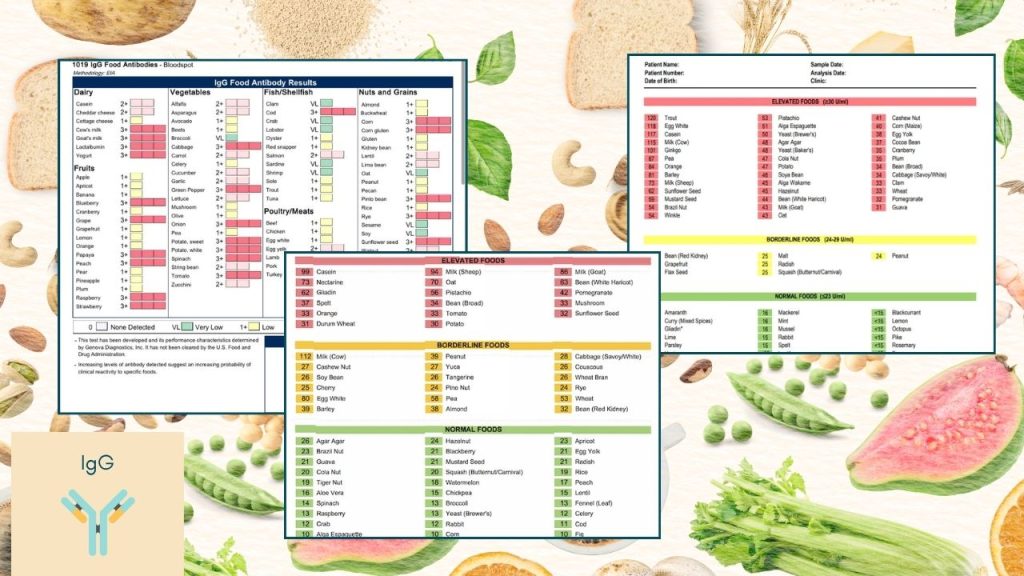
IgG test flagging quite a lot of foods
Your body is designed to interact with, and tolerate, a wide variety of foods.
Sometimes, eliminating a food does make you feel better. But it doesn’t necessarily tell us why you were reacting to the food in the first place.
If you are struggling with food sensitives, the likelihood is that something is going on in the gut. Food doesn’t act in isolation; it acts within the system it’s entering. Food sensitives are often a downstream result of:
If you don’t assess and address what is happening in the gut, then symptoms are highly likely to reoccur when your “reactive” foods are reintroduced.
For this reason, I do not rely on IgG testing alone.
If food sensitivities are suspected, in clinic there are two tests I may recommend.
1. Comprehensive stool test
I use Microba’s comprehensive stool test to get a detailed overview of the gut environment.
It looks at markers that may provide useful context around food reactions, including secretory IgA, zonulin, pancreatic elastase, pathogens and microbial metabolites such as butyrate and indole-3-propionic acid (IPA).
The findings help inform a personalised plan to support the gut environment. For example: by supporting microbial diversity, reducing inflammation, supporting the gut barrier and encouraging beneficial microbial metabolites. The aim is to shift the gut environment and immune system towards tolerance of as many foods as possible.
2. KMBO food inflammation test (FIT)
The FIT measures IgG antibodies 1 to 4 and a marker of inflammation, c3d. C3d is a protein fragment that helps to identify what food has triggered an active inflammatory response. Unlike most IgG tests, measuring both total IgG (IgG1-4) and c3d results in far fewer foods being flagged as “highly reactive” because it is not just measuring what the immune system has seen (exposure/ tolerance), but what is causing ongoing inflammation that can contribute to symptoms like bloating, skin rashes and headaches.
Additionally, the test measures four key markers that can help assess gut permeability: candida, zonulin, occludin, and lipopolysaccharides (LPS).
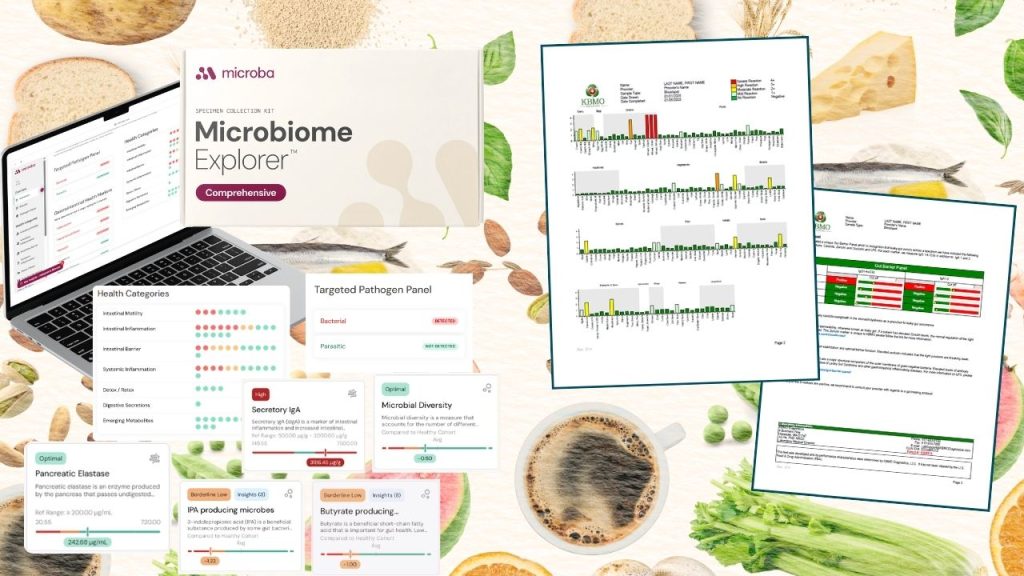
Left: Microba’s comprehenisve stool test. Right: KMBO food inflammtion test with gut panel.
In clinic, these tests are used alongside your symptoms and health history to create a personalised plan that is less restrictive and often more successful that IgG testing alone, or simply relying on guesswork and trial error.
In Summary
If you’re ready to explore which foods you’re reacting to — and why — I’d love to help.
Get personalised support for gut and skin health
References
Alpay, K., Ertas, M., Orhan, E. K., Ustay, D. K., Lieners, C., & Baykan, B. (2010). Diet restriction in migraine, based on IgG against foods: a clinical double-blind, randomised, cross-over trial. Cephalalgia : an international journal of headache, 30(7), 829–837. https://doi.org/10.1177/0333102410361404
Garmendia, J.V., De Sanctis, J.B., & García, A.H. (2025, Jun 26). Food-Specific IgG Antibodies: Decoding Their Dual Role in Immune Tolerance and Food Intolerance. Immuno, vol 5, issue 3. https://www.mdpi.com/2673-5601/5/3/25
GutMapDx. (2026, Mar 31). Food sensitives, testing controversies & clinical clarity with Josh Netherwood. Presentation.
Hardman G, Hart G (2007). Dietary advice based on food‐specific IgG results. Nutrition & Food Science, Vol. 37 No. 1 pp. 16–23, doi: https://doi.org/10.1108/00346650710726913
Ostrowska, L., Wasiluk, D., Lieners, C. F. J., Gałęcka, M., Bartnicka, A., & Tveiten, D. (2021). Igg Food Antibody Guided Elimination-Rotation Diet Was More Effective than FODMAP Diet and Control Diet in the Treatment of Women with Mixed IBS-Results from an Open Label Study. Journal of clinical medicine, 10(19), 4317. https://doi.org/10.3390/jcm10194317
Vidarsson, G., Dekkers, G., & Rispens, T. (2014). IgG Subclasses and Allotypes: From Structure to Effector Functions. Front. Immunol. 5:520. doi: 10.3389/fimmu.2014.00520
Vita, A. A., Zwickey, H., & Bradley, R. (2022). Associations between food-specific IgG antibodies and intestinal permeability biomarkers. Frontiers in nutrition, 9, 962093. https://doi.org/10.3389/fnut.2022.962093
Xie, Y., Zhou, G., Xu, Y., He, B., Wang, Y., Ma, R., Chang, Y., He, D., Xu, C., & Xiao, Z. (2019). Effects of Diet Based on IgG Elimination Combined with Probiotics on Migraine Plus Irritable Bowel Syndrome. Pain research & management, 7890461. https://doi.org/10.1155/2019/7890461