
You’ve cut out gluten. Maybe dairy too. You’ve tried probiotics, digestive enzymes, fibre supplements and every gut-health tip you’ve come across on social media.
You’ve seen your GP, had some tests done, and been told your results are “normal”.
And yet… you’re still bloated. Still constipated. Still rushing to the toilet. Still dealing with abdominal pain, unpredictable digestion or a gut that seems to have a mind of its own.
Meanwhile, your friend can eat whatever she likes and feel completely fine, while you seem to react to everything.
It’s frustrating. And it can leave you wondering whether you’re missing something, or whether this is just something you have to “learn to live with”.
But having ongoing gut symptoms doesn’t mean you haven’t tried hard enough. Sometimes, the problem is that you’ve been trying to fix individual symptoms without stepping back to look at the bigger picture.
Your digestion is influenced by far more than a single food or supplement. Stress, sleep, your menstrual cycle, medications, your diet as a whole, previous infections, gut motility and the wider gut environment can all play a role.
So rather than asking, “What else can I cut out?”, it may be time to ask:
“Why is my gut struggling in the first place?”
That’s where a more personalised approach can make a difference.



Trying different diets, supplements and lifestyle changes can absolutely be useful. In fact, the building the basics: eating a colourful varied diet, getting enough fibre, moving your body, prioritising sleep and managing stress, are important foundations for gut health.
But there comes a point where changing more things doesn’t necessarily mean getting closer to an answer.
The problem is that trial and error has a limit when you don’t know what you’re actually trying to change or why.
If you remove one food and your symptoms improve, was that food really the problem? Or did something else change at the same time? If a supplement doesn’t help, does that mean it wasn’t suitable for you? Or that it simply wasn’t addressing the underlying issue?
And when several factors could be contributing to your symptoms, changing one thing at a time can make it incredibly difficult to work out what is actually making a difference.
The elimination-diet cycle
This is one of the easiest traps to fall into.
Food is often the first thing blamed for gut symptoms like bloating. You notice that certain foods seem to make your symptoms worse, so you remove them. Perhaps you feel a little better, so you become more cautious about what you eat. Before long, your list of “foods I can’t eat” is getting longer and longer, but you still don’t necessarily understand why you’re reacting to them.
An unnecessarily restrictive diet can lead to food fear, nutrient deficiencies and can actually starve the microbiome, potentially making gut health worse, not better.
Rather than eliminating foods randomly, you need to figure out why these foods causing problems in the first place.
Food doesn’t act insolation; it responds to the system it is entering.
That might involve looking at: your overall diet, the diversity of your diet, fibre intake and fibre type, bowel habits, stress, sleep, gut barrier health, the gut microbiome, immune regulation, inflammatory load and your health history.
My aim in clinic is to get you tolerating as many foods as possible, not to restrict more foods.
Why generic advice can only take you so far
There’s no shortage of gut health advice online.
Take a probiotic.
Cut out dairy.
Eat more fibre.
Avoid FODMAPs.
Drink more water.
Take digestive enzymes.
Generic advice isn’t designed around your individual health history, symptoms, diet and circumstances.
A supplement stack that works brilliantly for one person may do very little for another. Increasing fibre can be helpful for some people with constipation, but someone with significant bloating may feel 10 times worse.
The more variables you change at once, the harder it becomes to know what is actually helping and what’s a waste of your effort and money.
Eventually, you can end up with a cupboard full of supplements, a growing list of foods to avoid and a long list of things you’ve already tried to no avail, but no clearer understanding of what your body actually needs.
That’s when more experimentation may not be the answer.
You may simply need more specific information.
There is a BIG difference between trying more things and understanding what is going on.
Getting to that point isn’t a sign that you’ve failed. It means you’ve reached the limit of what guessing can tell you.

This was me when I was struggling with post-infectious IBS.
I’d tried everything: going plant-based, going Paleo, eating low FODMAP, supplements, probiotics… you name it. My GP told me to “learn to live with it [IBS]”
For me, comprehensive stool testing was a game changer. It gave me information I hadn’t had before and, importantly, a much clearer direction for what to focus on next.
You can read more about my experience with IBS here.
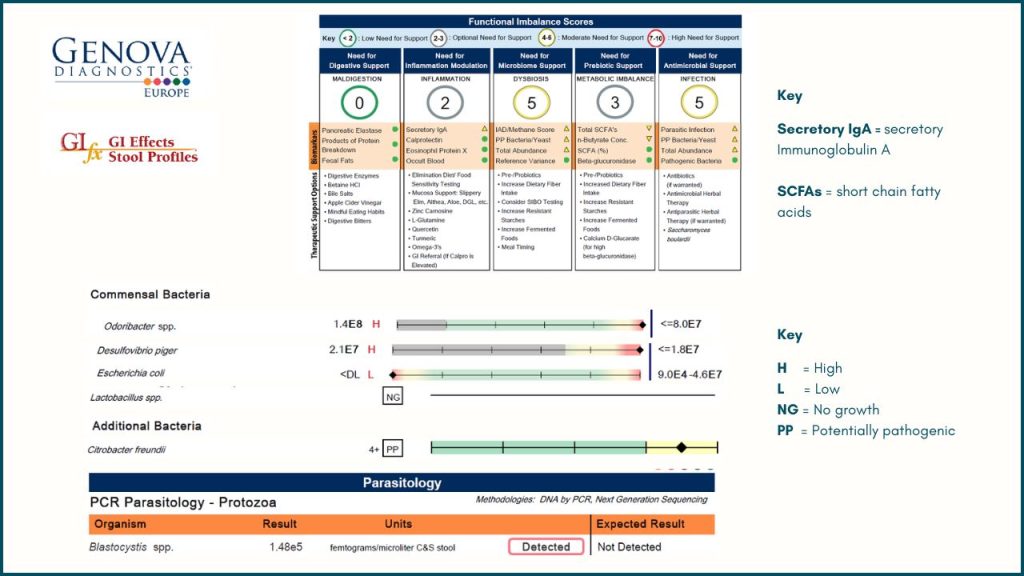
Some of the results from my stool test
Beyond “good” and “bad” bacteria
When people hear “gut bacteria”, it’s easy to picture two teams: the good guys and the bad guys.
But the gut microbiome is far more complicated than that.
Your gut is home to a vast community of bacteria, fungi, archaea, protists and other microorganisms. What matters isn’t simply whether a particular microbe is present, but the wider community it exists within, how abundant different species are, and what that community has the potential to do.
Some microorganisms can be perfectly harmless in one context but potentially problematic in another. In other words, the presence of a particular microbe doesn’t automatically tell us that it is “good” or “bad”.
Gut health isn’t about having more of the “good” bacteria and less of the “bad”. It’s about understanding the ecosystem as a whole.
That’s one of the reasons a comprehensive stool test can provide a very different kind of information from simply looking for a handful of individual organisms.
The kind of information it can offer
The stool test I use most often in clinic is Microba’s Microbiome Explorer Comprehensive.
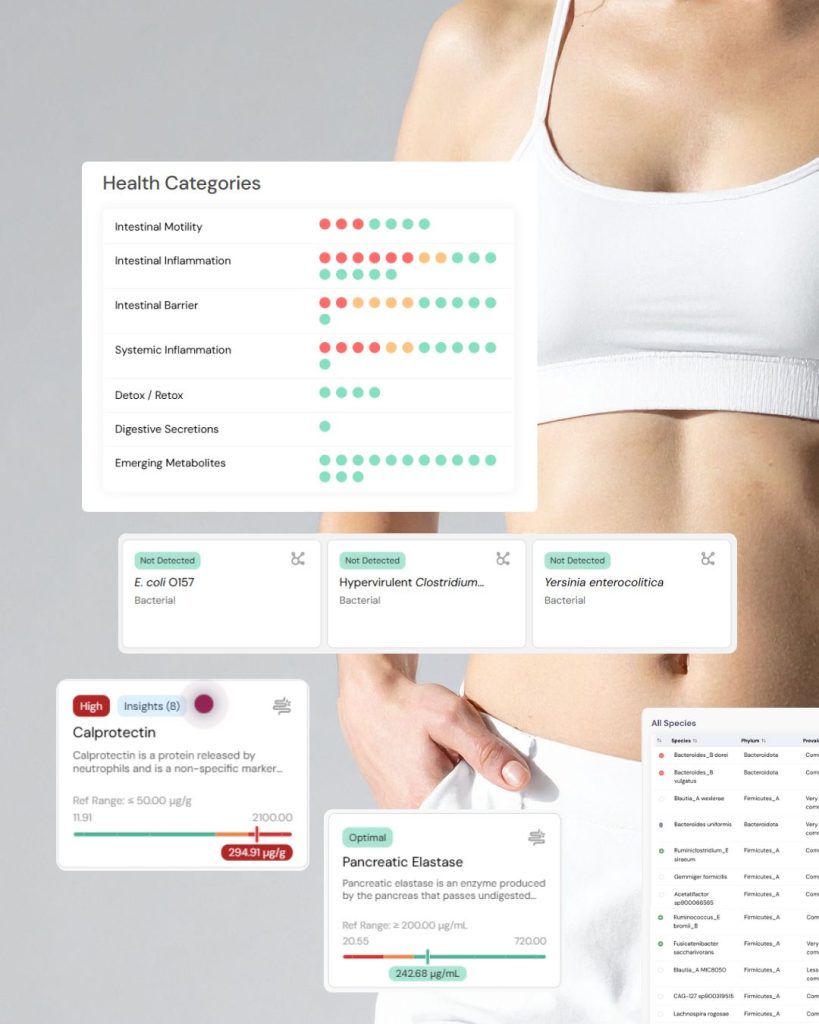
Rather than giving you a simple list of bacteria that are “good” or “bad”, it combines three different types of information from a single stool sample: microbiome profiling, gut health markers and pathogen screening.
For example, the microbiome profile can show:
It also assesses a range of gut health markers, including markers relating to digestion, inflammation, intestinal permeability and immune activity.
Additionally, the comprehensive test includes a pathogen panel, which screens for a range of bacterial pathogens and parasites.
This advanced stool testing allows us to move beyond looking at just bacteria and start asking more useful questions:
– What does the gut ecosystem look like?
– What is happening within that ecosystem?
– How does this information fit alongside symptoms, health history, diet and lifestyle?
Context is important. A stool test isn’t a diagnosis or a magic answer to unexplained gut symptoms. It is a source of information that, when interpreted alongside your individual picture, can help inform a more personalised approach.

Comprehensive stool testing isn’t necessary for everyone with gut symptoms, and it isn’t the first step for everyone.
But it may be worth considering if you recognise yourself in some of these:
A comprehensive stool test is not a diagnostic test and it should not replace appropriate medical assessment or treatment. There are also situations where further medical investigation or a different approach would be more appropriate.
That’s why I don’t recommend testing simply because someone has digestive symptoms.
Instead, I start by listening to you — your symptoms, health history, current diet and lifestyle, previous investigations and what you’ve already tried. From there, we can decide whether comprehensive stool testing is likely to provide useful information, or whether there’s a more appropriate next step.
A stool test provides a lot of information. But information on its own isn’t necessarily useful.
You could receive a detailed report showing hundreds of results that leave you overwhelmed and utterly confused, pondering ‘what the heck do these results mean for me???’
This is where interpretation matters.
I don’t look at your results in isolation. I consider them alongside your symptoms, health history, diet, lifestyle, previous investigations, medications and what you’re hoping to achieve.
You won’t be given a list of things that are “wrong” with your gut, or send you away with another one-size-fits-all protocol to follow.
The aim is to take a complex set of results and turn it into clear, practical information that’s relevant to you and helps guide your nutritional strategy.
That might mean identifying areas worth focusing on, considering where dietary or lifestyle changes would be apt, if target supplementation is appropriate, if a GP referral is needed, or simply providing a clearer direction after months of trying different things without seeing progress.
The test provides the data. Interpretation helps put that data into context.
It’s the difference between having a report sitting in a file, leaving you none the wiser — and understanding what your results mean for you, with a clear direction for moving forward.
If you’ve been dealing with persistent gut symptoms comprehensive stool testing may be worth considering.
If you’re unsure if testing is right for you, book a free 15 minute discovery call to briefly discuss your symptoms, health goals and what you’ve already tried. There’s no pressure to go ahead. If I don’t think testing is appropriate for you, I’ll tell you.
If we decide testing is appropriate, I’ll guide you through the process from the initial consultation and sample collection through to interpreting your results and discussing what they mean for you.
No referral is required. If anything comes up on the test that needs further investigation you will be referred to your GP.
Microba tests use advanced technology and up-to-date clinical insights. The test are only available through practitioners and cannot be purchased directly by consumers.
The value isn’t only the test; it’s having the results interpreted by a practitioner alongside your individual history and symptoms, rather than reading a report in isolation.
Depending on context, yes. What’s happening in the gut can influence the skin through the gut–skin axis, but the gut isn’t necessarily the driving factor behind everyone’s acne. For some people, diet, nutrient status or hormonal factors may play a more significant role.
Microba’s Comprehensive test typically takes around 3 weeks to process once your sample reaches the laboratory (based in Brisbane, Australia). Your results will then be reviewed and interpreted before your results consultation.
Rather than just improving general gut health, a comprehensive stool test helps us see where to focus attention.
It also looks at digestive function (pancreatic elastase), gut inflammation (calprotectin, lactoferrin, faecal occult blood, secretory IgA), faecal occult blood and pathogens. If these markers are out of range or if a particular pathogen is found, you will be referred to your GP for further investigations or treatment.
The stool test results are very detailed. You can have access to an interactive database or a PDF or your results.
You also get a results consultation to talk through what your results mean for you. Plus, a personalised written report and health plan which interpreting your results in the context of your symptoms, history, diet, lifestyle and goals.
References
Bharathi, S., Soundara Rajan, Y. A. P. A., Prakash, S., Immanuel, G., & Ramasubburayan, R. (2026). Pathobionts in the microbiome: Drivers of disease and targets for treatment. Microbial pathogenesis, 211, 108268. https://doi.org/10.1016/j.micpath.2025.108268
Microba. (2026, Aug 20). Don’t pull the wrong block! Why species-targeted treatment needs ecosystem data. https://www.microba.com/news/dont-pull-the-wrong-block-why-species-targeted-treatment-needs-ecosystem-data
Microba. (2026, Aug 24). Feed, feed, feed – not weed, seed, feed. https://www.microba.com/articles/feed-feed-feed—not-weed-seed-feed